

Quick Answer: Fentanyl charges in Colorado can range from simple possession allegations to serious felony accusations involving distribution, possession with intent to distribute, conspiracy, manufacturing, or overdose death investigations. Prosecutors must prove far more than the mere presence of fentanyl. Many cases involve disputes over possession, intent, weight, search-and-seizure issues, or whether law enforcement correctly interpreted the evidence.
If you have been arrested for fentanyl charges in Colorado, you may be facing one of the most aggressively prosecuted drug offenses in the state. Law enforcement agencies in Denver, Lakewood, Jefferson County, Adams County, Arapahoe County, and throughout Colorado devote significant resources to fentanyl investigations because of the connection between fentanyl and overdose deaths.
Yet a fentanyl accusation is not the same thing as proof. Many cases that initially appear overwhelming become much weaker after reviewing the search, the laboratory testing, the alleged weight, witness credibility, digital evidence, and the government’s theory of possession or distribution.
Jump to a Section:
Fentanyl charges in Colorado generally arise under Colorado’s controlled-substance statutes. Depending on the allegations, prosecutors may file charges involving:
Many people are surprised to learn that prosecutors do not always need evidence of an actual sale. A person can face serious felony allegations if police believe the circumstances suggest an intent to distribute fentanyl, even if no money changed hands.
Because fentanyl is frequently discovered during vehicle stops, search warrants, overdose investigations, or searches of homes and apartments, the legality of the police investigation often becomes one of the most important issues in the case.
Colorado prosecutors often treat fentanyl cases differently than other drug offenses because of the public attention surrounding fentanyl-related overdoses.
As a result, a fentanyl case may receive far more scrutiny than a case involving another controlled substance. Investigators often spend significant time reviewing:
Unfortunately, investigators sometimes jump to conclusions. The existence of fentanyl does not automatically prove distribution. Likewise, proximity to fentanyl does not automatically prove possession.
Many successful defenses begin by examining whether prosecutors are relying on assumptions rather than evidence.
A possession case typically focuses on whether prosecutors can prove that a person knowingly possessed fentanyl.
That sounds simple, but it often is not.
For example, fentanyl may be discovered:
When that occurs, prosecutors frequently rely on constructive possession. Instead of arguing that the fentanyl was physically on a person, they argue that the person exercised control over it.
Constructive possession cases are often much weaker than prosecutors initially suggest. The government must prove more than mere proximity. The defense may challenge whether the accused person actually knew the fentanyl was present or exercised control over it.
Fentanyl distribution Colorado cases are among the most serious drug prosecutions in the state.
Distribution allegations may involve:
One common misconception is that distribution always requires money to change hands. In reality, prosecutors may allege distribution even when they cannot prove a commercial sale.
That is one reason why distribution cases require careful analysis of the facts rather than assumptions based solely on police reports.
Many fentanyl cases are charged as possession with intent to distribute rather than completed distribution.
These cases often depend on circumstantial evidence.
Police may claim a person intended to distribute fentanyl because they found:
However, possession with intent is not the same thing as actual distribution. The government must prove intent beyond a reasonable doubt.
| Issue | Possession | Possession With Intent |
|---|---|---|
| Main Allegation | Knowing possession | Intent to distribute |
| Typical Evidence | Location and access | Quantity, cash, scales, phones |
| Defense Focus | Knowledge and possession | Intent and interpretation of evidence |
In many cases, the strongest defense is that the evidence is consistent with personal use rather than distribution.
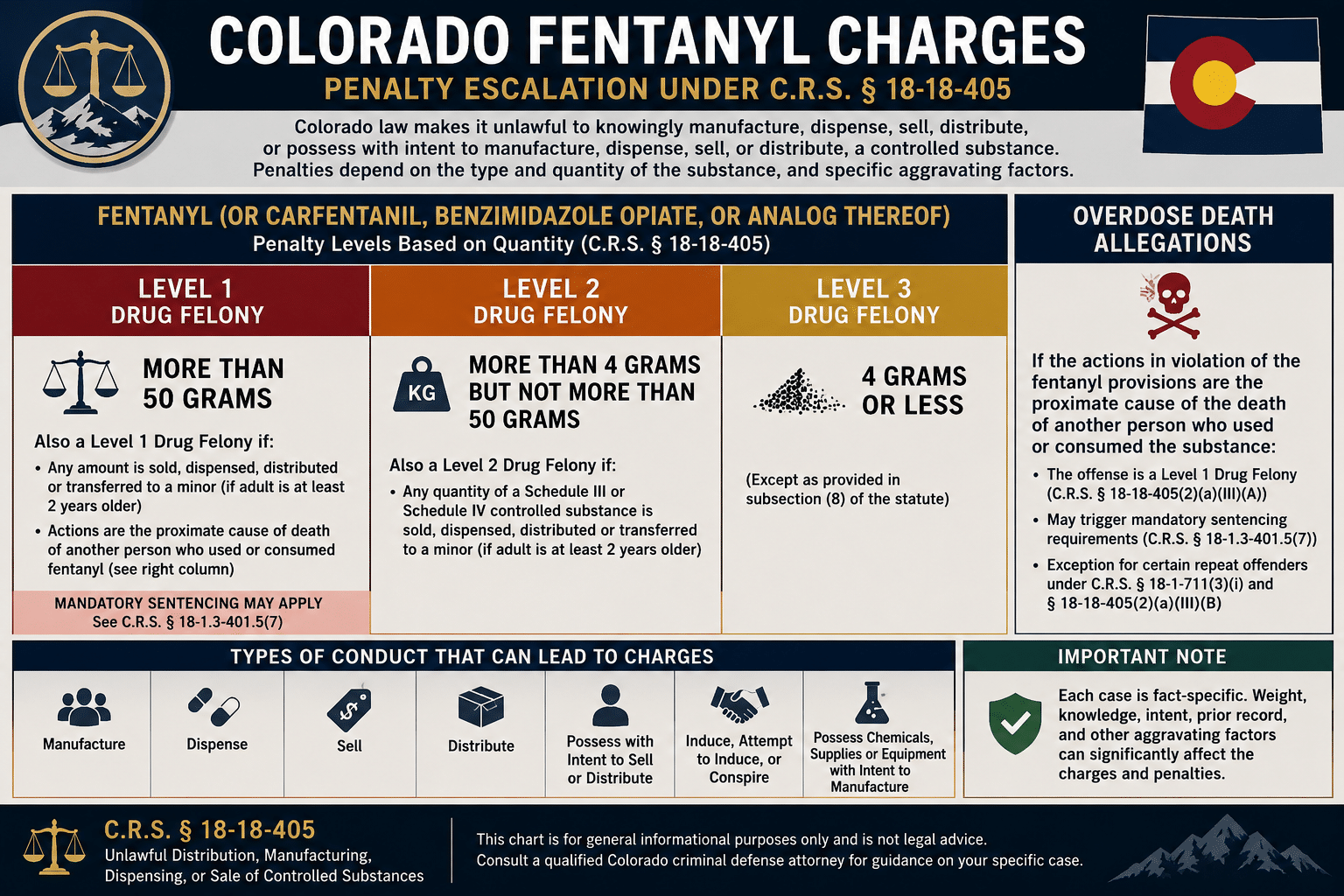
Under Colorado law, fentanyl-related substances are treated differently than many other controlled substances.
| Weight | Potential Charge Level |
|---|---|
| More than 50 grams | Level 1 Drug Felony Exposure |
| More than 4 grams but not more than 50 grams | Level 2 Drug Felony Exposure |
| 4 grams or less | Level 3 Drug Felony Exposure, subject to statutory provisions |
The weight calculation can dramatically affect the severity of the charge. A few grams may mean the difference between one felony level and another.
Because of that, the defense should carefully review:
Many fentanyl prosecutions involve counterfeit pills that resemble prescription medication. These pills are commonly referred to as M30 pills, blues, or counterfeit oxycodone.
Counterfeit pill investigations frequently raise important questions:
Knowledge often becomes one of the most important issues in counterfeit pill cases.
Some of the most serious fentanyl cases arise when prosecutors allege that fentanyl was the proximate cause of another person’s death.
These allegations often begin with an overdose investigation. Detectives may review phones, social media accounts, witness statements, surveillance footage, and digital communications to identify a suspected source.
However, proving causation is often far more complicated than it first appears.
Important questions include:
Overdose-death allegations often become battles between competing interpretations of complex medical and scientific evidence.
One of the biggest mistakes people make after an arrest is assuming that because law enforcement filed charges, the evidence must be overwhelming. In reality, many fentanyl charges in Colorado are built on assumptions rather than direct proof.
Some of the most common assumptions include:
In many cases, the defense focuses on separating assumptions from evidence.
The examples below are hypothetical situations based on issues that frequently appear in Colorado fentanyl investigations.
An officer stops a vehicle in Jefferson County for an alleged traffic violation. During the stop, police discover suspected fentanyl pills in the center console. There are four occupants in the vehicle.
Although police may arrest multiple people, prosecutors must still prove who knowingly possessed the pills. Access to a vehicle is not automatically the same thing as possession.
Police execute a search warrant in Denver and locate suspected fentanyl pills inside a shared residence. Multiple people live in the apartment.
The defense may focus on constructive possession issues and whether prosecutors can prove who exercised control over the drugs.
Investigators discover blue pills marked “M30” during a search. Prosecutors allege the pills contain fentanyl and claim the quantity suggests distribution.
The defense may challenge whether all pills were tested, whether the accused person knew the pills contained fentanyl, and whether there is actual evidence of distribution.
Police rely on a confidential informant to conduct a controlled buy. The informant has pending criminal charges and hopes to receive favorable treatment.
In these situations, credibility becomes a central issue. Jurors may question whether the informant had a motive to exaggerate or shift blame.
After a fatal overdose in Adams County, investigators review phones and social media accounts in an effort to identify a possible source of fentanyl.
These cases often involve complicated issues of toxicology, causation, timing, and proof of distribution.
The strongest defense depends on the facts of the case, but several defense strategies appear repeatedly in fentanyl prosecutions.
Many fentanyl cases begin with a traffic stop, vehicle search, search warrant, or home search. If police violated constitutional protections, evidence may be subject to suppression.
The government must prove possession. If fentanyl was discovered in a shared location, vehicle, apartment, or hotel room, possession may be heavily disputed.
Distribution allegations often depend on police interpretation. The defense may argue the evidence supports personal use rather than distribution.
The prosecution must prove the substance actually contained fentanyl. Laboratory procedures, chain of custody, and testing methods should be carefully reviewed.
Weight thresholds can dramatically affect the felony level. The defense should review whether the laboratory measured the substance accurately.
Text messages can be misunderstood, misinterpreted, or taken out of context. Prosecutors often present messages in a manner that appears more incriminating than the actual conversation.
Confidential informants may receive payment, favorable treatment, or reduced charges. Those incentives can affect credibility.
In overdose-death cases, prosecutors must prove more than a tragic outcome. Toxicology, timing, source evidence, and causation frequently become contested issues.
Fentanyl prosecutions are common throughout the Denver metropolitan area. Law enforcement agencies in Denver, Lakewood, Jefferson County, Adams County, Arapahoe County, Douglas County, and Weld County frequently investigate alleged fentanyl distribution, possession with intent to distribute, and overdose-related cases.
Although the charges may look similar on paper, each jurisdiction approaches these cases somewhat differently. The local prosecutor, the investigating agency, the judge, and the specific facts of the case can all affect the outcome.
That is why it is important to evaluate the actual evidence rather than relying on assumptions about what the charge means.
What happens immediately after an arrest can have a significant impact on the case.
In most situations, it is safer to remain silent and speak with a criminal defense lawyer before answering questions.
Fentanyl cases are often built on circumstantial evidence. Prosecutors may rely on quantity, messages, cash, packaging, informants, or assumptions about possession and intent.
A defense lawyer can evaluate:
Josh Landy is a former Colorado State Public Defender and trial-focused criminal defense lawyer who has spent years defending people accused of serious felony offenses throughout Colorado.
If you are facing fentanyl charges in Colorado, obtaining experienced legal representation early in the process can make a substantial difference.
Schedule a confidential consultation today.
Fentanyl charges can range from possession allegations to serious felony accusations involving distribution, possession with intent, or overdose death investigations.
Yes. Prosecutors sometimes file possession-with-intent-to-distribute charges even when there is no evidence of a completed sale.
Counterfeit M30 pills are pills designed to resemble prescription oxycodone. Prosecutors often allege these pills contain fentanyl.
Yes. Investigators frequently rely on text messages, but those messages may be challenged based on context, interpretation, or authorship.
Yes, but prosecutors still must prove knowing possession. Mere presence is not enough.
Yes. Laboratory testing is generally necessary to establish the identity of the substance.
The government may need to prove source, causation, timing, toxicology, and other scientific issues before obtaining a conviction.
Common defenses include illegal searches, lack of possession, lack of intent, laboratory testing issues, weight disputes, informant credibility challenges, and overdose causation defenses.
Generally, it is safer to remain silent and speak with a lawyer before answering questions.
