

If police have contacted you about a sexual assault allegation, it may feel like your opportunity to explain what really happened. However, investigators do not approach these conversations the way most people expect.
Instead, they use what you say to begin building a case. Because of that, understanding how statements become evidence can directly affect what happens next.
This visual shows how a sexual assault investigation can move from a conversation to a criminal case.
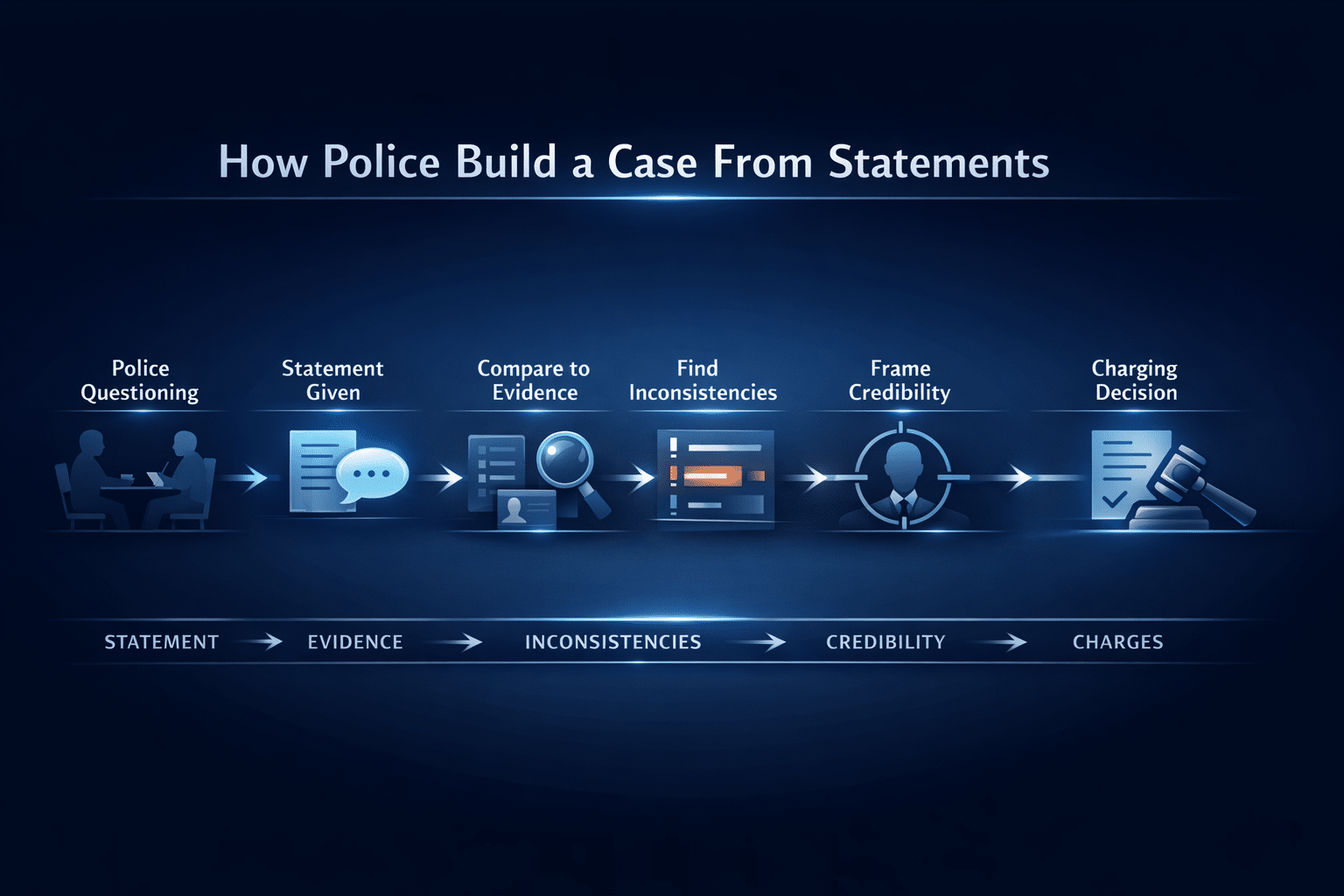
How a statement becomes a case: police questioning, evidence comparison, credibility analysis, and charging decisions.
This breakdown shows how statements, evidence, and credibility work together during a sexual assault investigation.
Police do not ask questions to help you explain your side. Instead, they ask questions to create evidence they can later use.
At the beginning, investigators want you to talk. Once you do, your version of events becomes the reference point for everything that follows.
From that moment forward, your words are no longer flexible. Instead, investigators measure every future detail against what you already said.
What this means:
Next, investigators begin comparing statements. They line up your version, the reporting party’s version, and any available evidence.
Importantly, they do not focus only on major contradictions. Instead, they look for smaller differences they can highlight later.
What gets compared:
In many cases, investigators do not have clear physical evidence. Therefore, credibility becomes the focus.
As a result, even small differences can take on more importance than they should. Investigators may later present those differences as signs of dishonesty or inconsistency.
How this may be used against you:
Finally, investigators organize everything into a report for a charging decision. At that stage, they no longer focus on understanding what happened. Instead, they focus on whether the case can move forward.
Because of that shift, early statements often carry significant weight. By the time charging decisions happen, your words may already play a central role.
How the process often works:
Statement → Comparison → Highlight Differences → Frame Credibility → Recommend Charges
Most people speak because they believe it will help. For example, they want to explain, clarify, or correct something.
However, once you make a statement, it becomes evidence. Therefore, what feels helpful in the moment can create problems later.
Instead of reacting immediately, it helps to pause and evaluate the situation. This approach allows you to make decisions strategically.
Defense does not begin during questioning. Instead, it begins after you understand the full picture.
At that point, the strategy may involve analyzing credibility, rebuilding timelines, and identifying weaknesses in the investigation.
To learn more about how these cases develop, visit our guide on
how investigations unfold.
In addition, if the situation involves disputed claims, our page on
false allegations explains additional strategies.
If you have already spoken to police, you are not alone. In fact, many people do.
However, the focus then shifts. Instead of preventing the statement, the strategy focuses on how to interpret, challenge, and contextualize what was said.
If you are under investigation, the most important move is not reacting quickly. Instead, it is reacting correctly.
Understanding how a case gets built is the first step toward building a defense.
